
Engineered Stone Benchtops: What’s Banned, What’s Legal
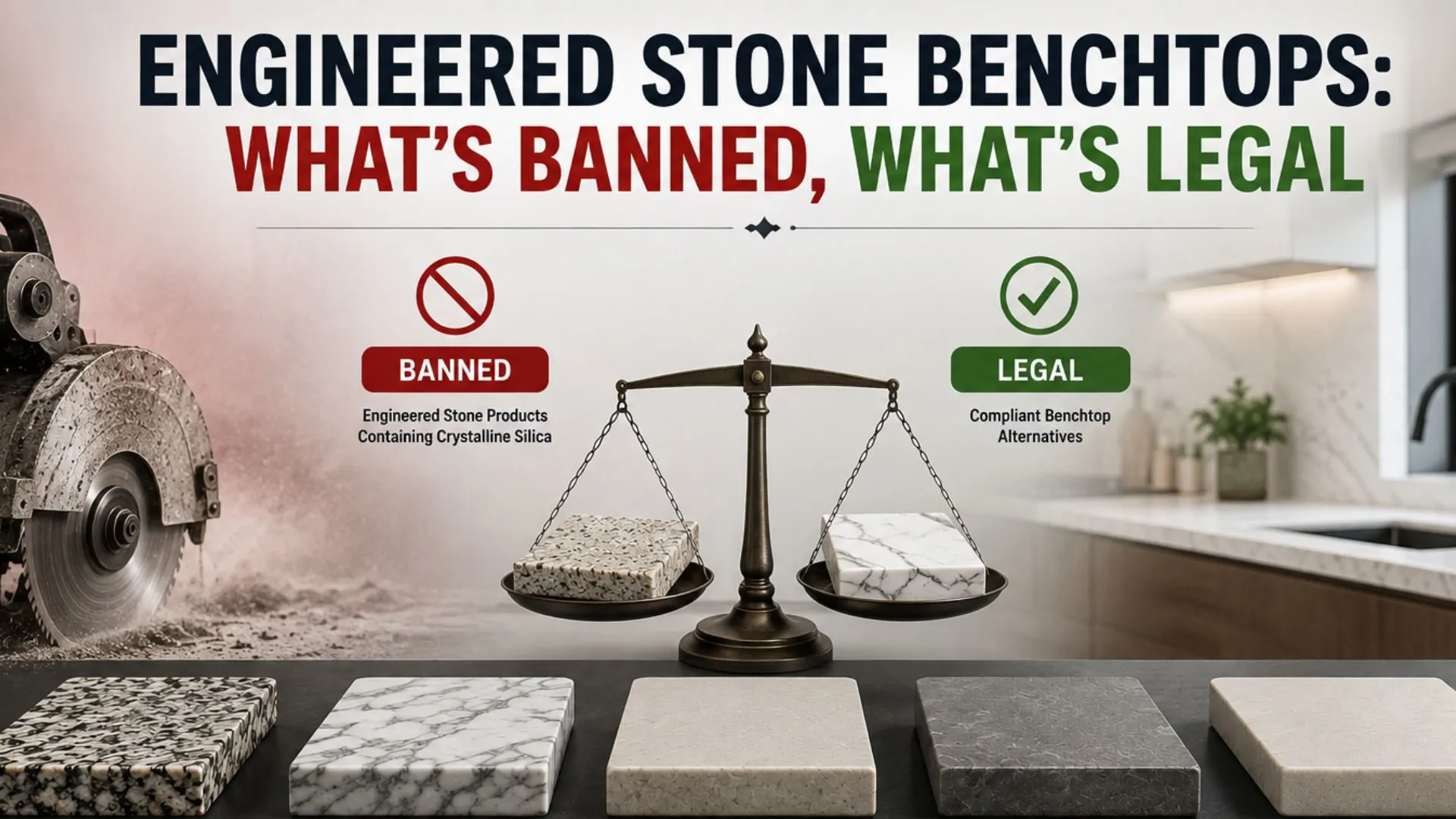
Kitchen benchtop shopping in Australia has changed dramatically. Since 1 July 2024, national rules have prohibited the manufacture, supply, processing and installation of certain Engineered Stone Benchtops, panels and slabs. The change was introduced to reduce workers’ exposure to dangerous respirable crystalline silica dust. But here is where confusion starts. There are no bans for any manufactured surfaces, and an already in place benchtop does not necessarily require replacement. New kitchen designs are still available in gorgeous natural, porcelain, sintered and other compliant surfaces for homeowners to choose. This article outlines what is banned and what isn’t and how to select an Australian compliant benchtop suitable for your home.
What is Engineered Stone?
As per WHS rules in Australia, Engineered Stone is an artificial product with at least 1% crystalline silica in its composition, produced by mixing natural stone materials with other chemical constituents (such as resin, pigment or water) prior to the mixture hardening. This is normally fitted with traditional quartz based engineered stone kitchen benchtops. The main ban lies within manufacturing, processing, and supplying engineered stone. During the processing stage, cutting, grinding, and drilling of this engineered stone emit silica dust particles that are detrimental to the workers.
Know the Ban: Engineered Stone Is No Longer Allowed?
Australia’s rules focus on specific stone benchtops, panels and slabs rather than placing a blanket ban on every manufactured or composite building surface.
Engineered Stone Benchtops, Panels and Slabs
As of 1 July 2024, businesses in Australia are not able to manufacture, supply, process or install engineered stone benchtops, panels or slabs. Homeowners looking for a new kitchen are no longer limited to the earlier transitional options for qualifying contracts. They must source compliant raw materials for their kitchen instead of the old banned stock.
Cutting, Shaping and Processing
The ban is not only on the sale of a finished slab. It is not allowed for processing products also. This includes fabrication work in building newly banned benchtops for installation. Existing installed stone is excluded: only limited repair or minor modification, removal and disposal are permitted under strict requirements. Do not alter, cut, drill or grind legacy stone, unless supervised by a professional contractor.
Manufacturing and Supplying New Engineered Stone Products
A fabricator cannot simply manufacture a prohibited slab and sell it as a new kitchen surface. Supply and installation are covered by the Australian prohibition alongside manufacturing and processing. The Commonwealth also prohibited imports of affected engineered stone benchtops, panels and slabs from 1 January 2025, adding another control at the Australian border.
Don’t Confuse Engineered Stone With Every Composite Surface
The term “engineered” can make the rules seem more general than they actually are. There are a number of manufactured products not covered under the regulated definition. For instance, a surface made of artificial stone that contains less than 1% crystalline silica does not qualify as such. Another option is excluded: resin free porcelain or sintered stone. Concrete, cement products, and ceramic wall or floor tiles are among other exclusions. Therefore, it’s important that homeowners look past banned items and investigate exactly what a product contains and how it’s documented.
What Does the Ban Mean for Homeowners?
If you are building or renovating now, you cannot order a new prohibited Engineered Stone benchtop and have it fabricated or installed through the old process. Instead, your designer or stone supplier should guide you towards materials that meet current requirements. Already installed stone is another story. As per SafeWork SA, if already installed before the ban, you do not have to remove it, provided you do not do any additional construction on the surface. If somehow you need to repair or install something alternative, contact a professional.
Pick Your Alternative: Safer and Legal Options for Your Kitchen
Losing one familiar surface category does not mean losing choice; several materials can provide the color, movement, durability, and finish homeowners previously sought from quartz style benchtops.
Go Natural with Granite or Marble
Granite and marble take the focus back onto real natural stone. These are not the banned engineered stone kitchen benchtops. The strength properties of granite are ideal to withstand wear and tear of regular kitchen use, whereas marble enhances aesthetics. Professional natural stone fabrication is done based on silica control requirements.
Keep It Simple with Porcelain or Ceramic
Porcelain is the ideal alternative to engineered stone as it serves the purpose of bringing a neat and contemporary appearance to home interiors. Patterns that can replicate concrete, stone, and marble styles can create the same look without just substituting outdated quartz pieces with another surface with the same legal designation.
Explore Solid Surface and Other Options
A stone filled kitchen isn’t the only option. Some of the materials available as alternatives include solid surface materials, stainless steel, timber, laminate, recycled glass, polished concrete and sintered stone, according to SafeWork SA. There are advantages and disadvantages to each. Smooth modern shapes can be achieved using solid surface, and “stone-like” finishes can be achieved using sintered products. Before making a selection, consider: maintenance, heat performance, appearance and fabrication requirements.
Shop Smart: What Should You Check Before Buying?
If you were originally searching for Engineered Stone Benchtops Adelaide, shift the conversation from familiar product labels to documented composition, compliance and practical kitchen performance.
- Ask exactly what the slab is made from. Avoid terms like “new generation stone”, “mineral surface” or “quartz alternative”. Always ask the supplier to provide the mineral percentages of the product. Especially look for crystalline silica and resin content.
- Check that the product suits its intended use. Even if it is a legal surface, it must still function in a kitchen. Before buying a color, compare stain resistance, heat tolerance, edge possibilities, cleaning, slab size and maintenance requirements.
- Choose an informed fabricator and installer. Materials containing crystalline silica may remain subject to workplace controls even when they are not prohibited engineered stone. A knowledgeable Adelaide supplier should understand current product classifications and arrange fabrication using the required safety practices.
Choose a Compliant Benchtop Without Compromising Your Design
Breaking away from the use of older quartz materials can actually start the design process by offering a range of options during the process: a variety of textures, natural patterns, and modern surfaces.
- Start with the look, then match the legal material. Love bold veining? Think about using a marble, or other compatible surface with similar visual dynamism. Looking for darker, earthy patterns? Every slab can be unique when given the right granite.
- Think about the entire kitchen, not just the slab. From choosing the color on your cabinets to splashbacks, flooring styles, and lighting, all affect the final outcome. A well planned, compliant surface can still look amazing, like Engineered Stone Benchtops.
- View full slabs wherever possible. Small samples rarely show the complete pattern. Anyone comparing Engineered Stone Benchtops Adelaide with today’s compliant choices should view larger sections, discuss joints and edges, and understand how the finished stone will sit within the room.
Conclusion
Australia’s ban has transformed kitchen renovation, but hasn’t removed good design from the menu. The only thing that homeowners must know is which products are not allowed and which are acceptable for the existing needs. For existing installed surfaces, compliant surfaces can continue to be used, and new projects can be designed to incorporate granite, marble, and porcelain. Emperor Stone has granite and marble among its stone types and serves Adelaide residents. Come up with your kitchen ideas at Emperor Stone and select something unique, compliant, and ideal for your living space.


The Finest Stone
Benchtops
Stones & Colours
Contact Information
Emperor Stone & Marble Pty. Ltd.
82 Wingfield Road,
WINGFIELD, SA 5013
Mobile: 0400 011 555
Tel: (08) 8244 3300
Email: info@emperorstone.com.au
For any complaints or concerns, please get in touch with us – +61 450 480 849
(C) 2015- 2026 Emperor Stone | Terms of Use and Privacy Policy. Powered by: VR Bonkers